
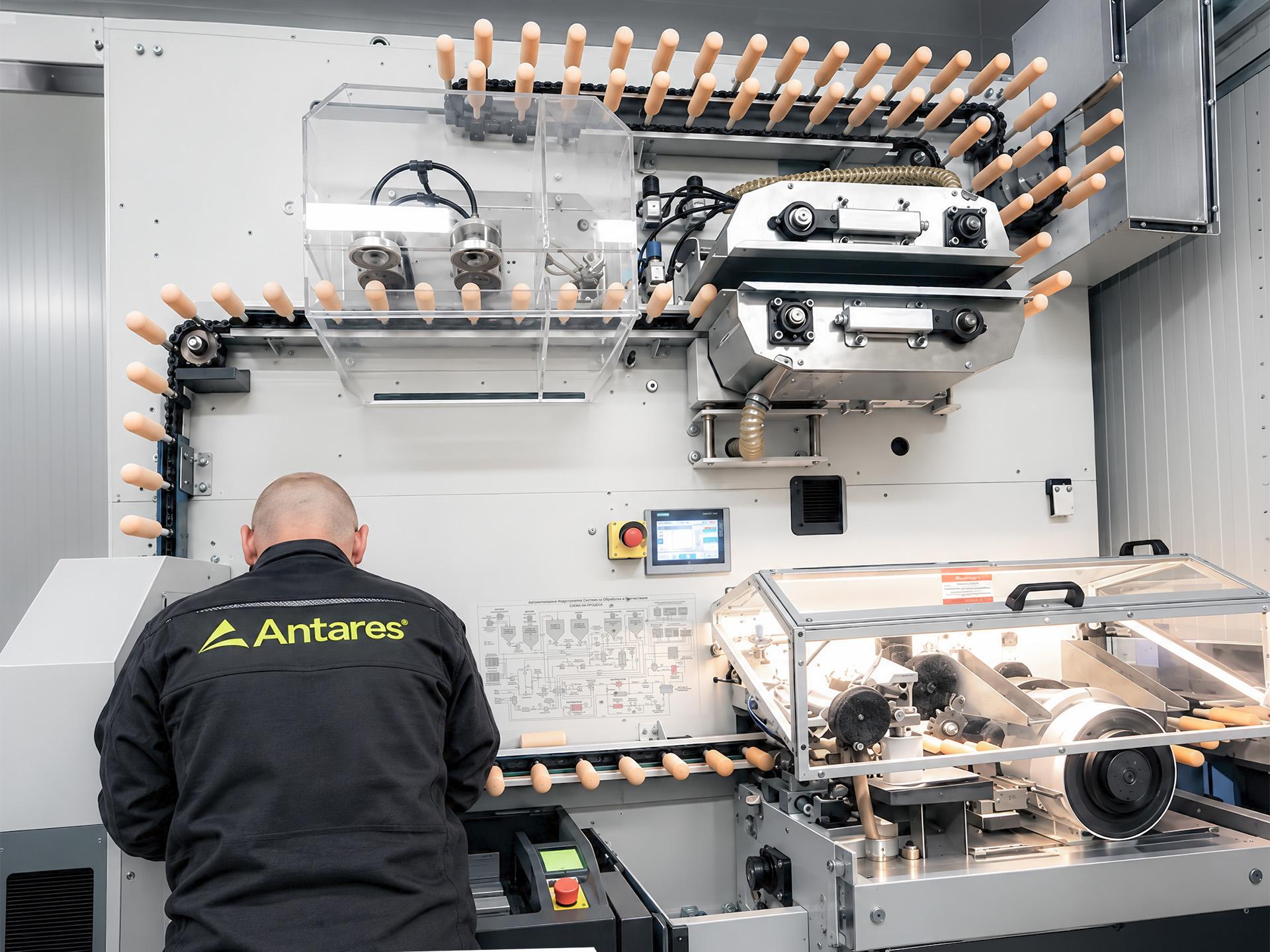
Flock line with machine vision
Antares makes flock paint rollers in-house on a computer-controlled flock line, with an output of up to 2,000 rollers per hour. Every roller is checked by a machine vision system before it leaves the line.
How flocking works
- Loading. High-density polyurethane foam cylinders are loaded onto spindles mounted on a conveyor.
- Adhesive. An adhesive station applies a thin layer of water-based adhesive with mild solvent resistance. The layer thickness is controlled by the line.
- Flocking. In the flock chamber, 1.4 mm trilobal polyamide fibres are applied to the cylinders in a high-intensity electrostatic field. The line's computer regulates field intensity, fibre density and feed rates in real time.
- Drying. Drying chambers remove the excess moisture. Process timing, temperature and humidity are monitored throughout.
- Cleaning. Mechanical cleaning, air blades and ionising rotary heads remove loose fibres from the roller surface.
- Inspection. A machine vision system checks every roller for dimensional accuracy, fibre distribution and surface uniformity against set technical and visual specifications.
Technical data
- Output: up to 2,000 rollers per hour
- Base: high-density polyurethane foam cylinders on conveyor-mounted spindles
- Adhesive: water-based, mild solvent resistance
- Flock: 1.4 mm trilobal polyamide fibres, applied electrostatically
- Monitored in real time: electrostatic field intensity, fibre density, material feed rates, process timing, temperature and humidity
- Cleaning: mechanical, air blades, ionising rotary heads
- Inspection: machine vision on every roller
- Roller sizes: Ø35 mm in lengths of 50, 70, 110 and 160 mm; Ø50 mm in lengths of 100 and 150 mm
Process control
The line's computer corrects deviations as they occur, so the settings for each roller size stay the same from batch to batch. Quality control runs in three stages, and every batch is traceable.
What this means for you
Each flock roller is inspected individually, not by sampling, and loose fibres are removed before packing. If a question comes up about a delivery, the batch can be traced back through production. Flock rollers are available under the Antares brand or as private label, with the customer's own label.
Frequently asked questions
How are Antares flock paint rollers made?
Polyurethane foam cylinders receive a thin layer of water-based adhesive and are flocked with trilobal polyamide fibres in an electrostatic field. They are then dried, cleaned and inspected one by one by machine vision.
How many flock rollers can Antares produce?
The flock line produces up to 2,000 rollers per hour.
How does Antares check the quality of flock rollers?
Machine vision inspects every roller for dimensional accuracy, fibre distribution and surface uniformity. Quality control runs in three stages, and every batch is traceable.
More technologies: Tube extrusion · Fabric slitting · Thermobonding · Cutting and finishing · Roller frames · Bristle mixing. See also Paint rollers and Private label.