
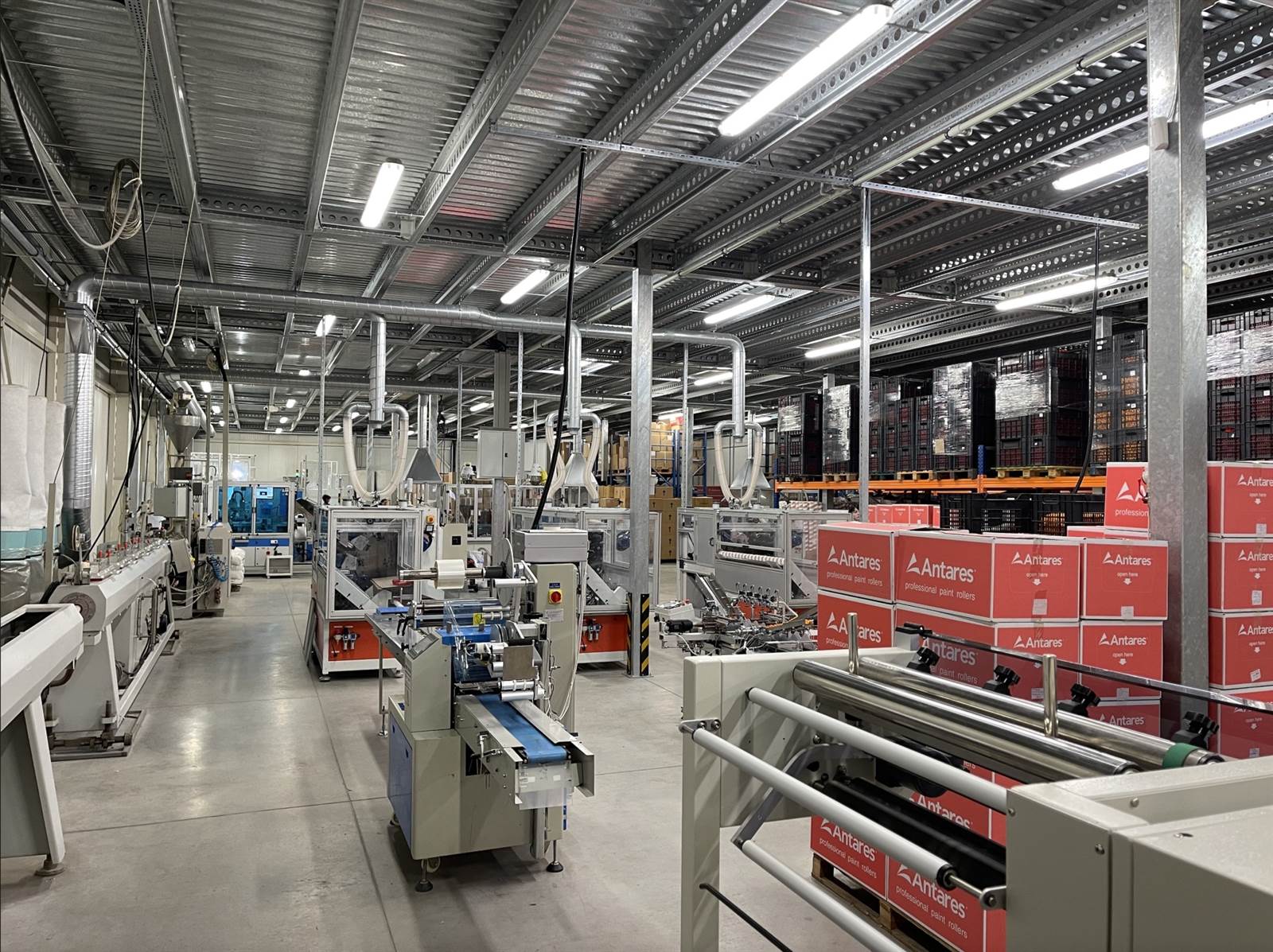
New Technologies Section: How Antares Makes Paint Rollers and Brushes
Ten new pages show how Antares paint rollers and brushes are made, from raw materials to the packed product.
Antares has added a Technologies section to its website. It describes the ten main production processes in the Antares factory. The production cycle is fully closed: only raw materials are purchased, and the tubes, frames, refills, brushes and plastic parts are made in-house.
The ten processes are:
- Tube extrusion – roller cores from Ø15 to Ø52 mm;
- Fabric slitting – roller fabric cut into 35, 50 and 73 mm strips;
- Thermobonding – fabric bonded to the core with heat, without glue;
- Cutting & finishing – rollers from 120 to 500 mm, finished in 8 stages;
- Roller frames – frames from Ø6 and Ø8 mm electro-galvanised wire;
- Bristle mixing – up to four filaments mixed to a set recipe;
- Paint brush line – a robotised line for brushes 20–120 mm wide;
- Injection moulding – 10 machines and 38 own moulds;
- Flocking – a fully automated electrostatic flocking line;
- Shrink-wrapping – 4 automatic lines for rollers from 90 to 500 mm.
Each page explains how the process works, gives the main technical data and describes how quality is checked at that stage. It also answers common questions – for example, whether Antares paint rollers are glued. They are not: all fabric paint rollers are thermobonded.
For distributors and paint manufacturers, the section shows what stands behind an Antares or private label product: the materials, the machines and the checks at each stage. Own-brand production is described on the Private Label page.