
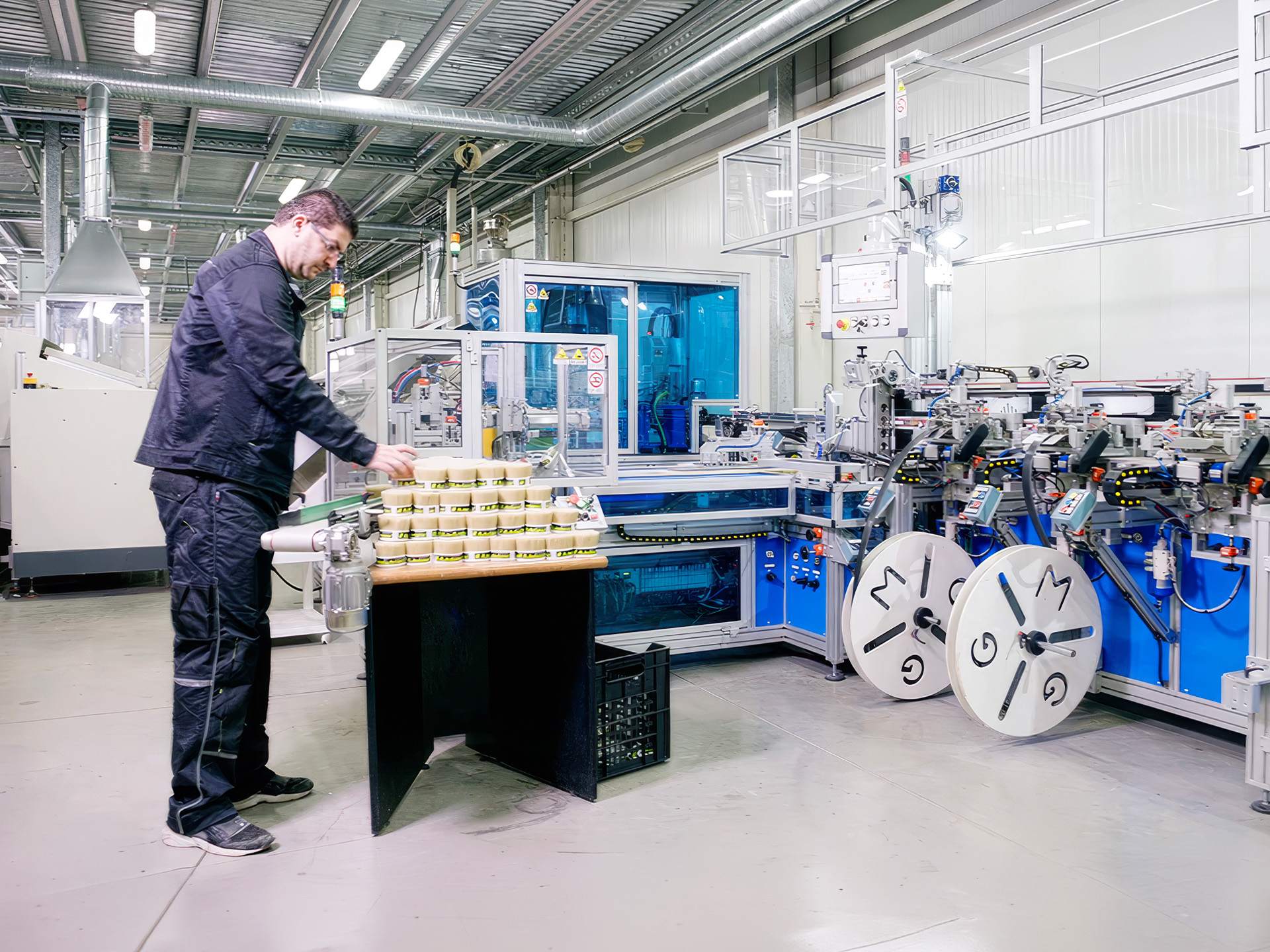
Automated paint brush line
Antares makes its paint brushes on an automated, modular line at 1,200 to 1,450 brushes per hour. The line covers every step from feeding the bristle or synthetic filament to a wrapped, printed, labelled and boxed brush.
How the paint brush line works
Each module of the line performs one function. All modules communicate over EtherCAT EAP, so the whole process is controlled in real time.
- Ferrule inspection. A conveyor feeds the ferrules to a robot. An infrared camera with OMRON machine-vision software checks the orientation and quality of each ferrule, and only approved ferrules go on to head making.
- Filament feeding. The filament module unpacks each bundle automatically and loads the magazine of the head-making machine. The bundles come from the bristle mixing machine.
- Head making. The filament is placed in the ferrule, and polypropylene wedges are inserted to form the paint reservoir. The head is then settled at four vibration stations with eccentric and amplitude vibrators.
- Epoxy setting. A manipulator moves the head into the curing tunnel. Epoxy resin is injected in a pattern programmed on the HMI to bond the filament to the ferrule, and computer-controlled temperature brings the resin to full cure by the tunnel exit.
- Nailing. The handle is fitted and fixed to the head with four chrome-nickel nails.
- Cleaning. The finishing module cleans the assembled brush in four stages to remove loose filament.
- Wrapping and marking. The brush head is wrapped in clear film. The next modules print a logo or text on the handle and apply the label.
- Final inspection and boxing. An operator inspects every finished brush before it is packed into a carton.
Technical data
- Output: 1,200 to 1,450 brushes per hour
- Brush widths: 20 to 120 mm
- Line control: modular, all modules connected over EtherCAT EAP
- Ferrule inspection: infrared camera with OMRON machine-vision software
- Vibration: 4 stations, eccentric and amplitude vibrators
- Bonding: epoxy resin, injection pattern programmable on the HMI
- Head fixing: 4 chrome-nickel nails
- Cleaning: 4 stages
Process control
Faulty or wrongly oriented ferrules are removed before they reach head making. The epoxy pattern and the curing temperature are set by program, so each brush size is bonded the same way every time. The last check is made by a person, not a sensor.
What this means for you
Epoxy and four nails hold the filament firmly in the ferrule, and four-stage cleaning helps prevent shedding in use. For private label, the line prints the customer's logo or text on the handle and applies the customer's label itself, so the brushes come off the line wrapped, marked and boxed.
Frequently asked questions
Are Antares paint brushes made automatically?
Yes. They are made on an automated modular line at 1,200 to 1,450 brushes per hour, from filament feeding to wrapping, printing and labeling. An operator inspects every brush before boxing.
How does Antares keep bristles in the brush?
The filament is bonded to the ferrule with epoxy resin, cured at computer-controlled temperature, and the head is fixed to the handle with four chrome-nickel nails. Four-stage cleaning then removes loose filament before packing.
What paint brush widths does Antares make?
Paint brushes from 20 to 120 mm wide.
More technologies: Bristle mixing · Injection moulding · Tube extrusion · Fabric slitting · Thermobonding · Cutting and finishing · Roller frames · Flock line. See also Paint brushes and Private label.